Bomber Ace: WW2 war plane game
- 4.5
- Rating
- 5.00M
- Installs
- Free
- Price
 Analysis by App-foxy
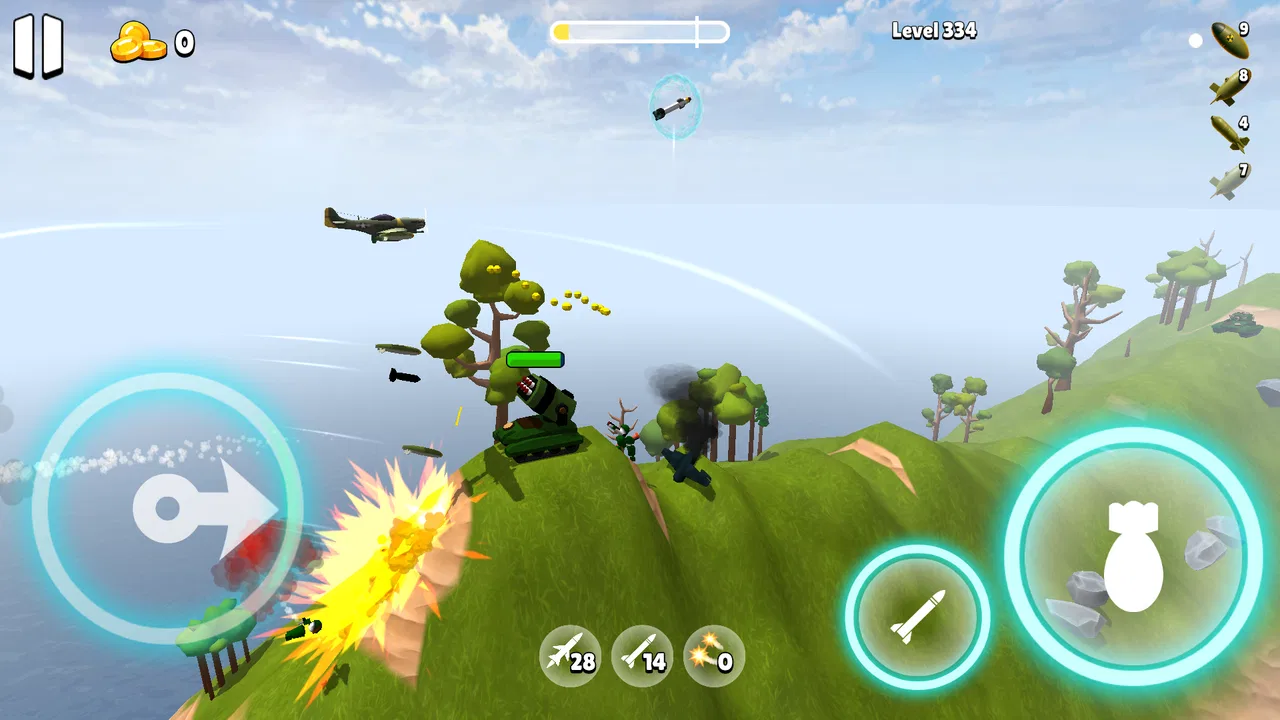
Bomber Ace: WW2 war plane game is the kind of action title I can imagine passing around on a shared tablet during a quiet afternoon. One person can take a short turn, hand the device over, and let someone else try to beat the previous run. Its focus is straightforward: fly into dangerous World War II missions, attack enemy convoys, hit bases, and send aircraft carriers beneath the waves. I found that direct objective more appealing for casual household play than a complicated strategy game that needs a long explanation before anyone can enjoy it.
MadFatCat keeps the experience centered on aerial action rather than historical research or a large management layer. That makes it easy to understand, but it also sets clear expectations. This is a free action game for Android, not a detailed flight simulator and not a substitute for a deep campaign game. I would recommend it to someone who wants quick bombing missions and accessible controls, while warning simulation fans that the simplified approach may feel too light.
How it works when several people share the device
The most natural household use is a turn-based challenge without needing to turn the game into a formal family activity. I might play until a mission goes badly, then give the tablet to a younger relative or a friend and see whether they can do better. Because the central fantasy is immediately visible—pilot a bomber, choose targets, and survive the attack—the next player does not need a long tutorial from me to understand the point.
You May Also Like

 Blood Strike: 2.5 Anniversary
Blood Strike’s Loadouts Turn Every Drop Into a Tactical Gamble
A close look at Blood Strike’s custom loadouts: how fast access to signature weapons reshapes its battle royale rhythm, rewards preparation, and narrows the gap between fights.

 Pandora - Music & Podcasts
Pandora’s Music Is Easy to Start, but Harder to Recover
Pandora’s strength is its low-effort path from a seed to a station. Its weak spot is how much confidence it asks you to place in connection, setup, and quiet recovery.

 8 Ball Pool
 Is Built on Rivalries, Rematches, and Routine
A close look at the rivalries, rematches, shared routines, and unanswered safety questions that turn a quick pool match into a persistent mobile community.

 Samsung Music
’s Quiet Strength Is Playing What You Already Own
Its reach comes less from spectacle than from dependable access to a personal library. That simplicity is both the app’s strongest retention engine and its ceiling.

 AccuWeather: Weather Radar
AccuWeather Review: A Quick, Clear Forecast for Everyday Decisions
For everyday plans, the best forecast is the one you can understand quickly. AccuWeather makes rain timing, radar, and local conditions easy to act on, with a few trade-offs.

 Hill Climb Racing
Why Hill Climb Racing Still Turns Crashes Into One More Run
A tiny car, a bumpy hill and one more upgrade: Hill Climb Racing keeps resurfacing because its simple chaos makes every near-miss feel personal.
More From Our News Desk



That simplicity is useful when everyone has a different level of gaming experience. A person who rarely plays action games can start by concentrating on staying alive and reaching the target. Someone more comfortable with mobile controls can try to improve the attack run, avoid unnecessary danger, and finish more efficiently. The game therefore works well as a short shared-device activity, although it is not something I would describe as a built-in multiplayer session. The social element comes from taking turns and comparing results in the room.
In a realistic everyday situation, I would use it during a waiting period or after dinner, with each player taking a few missions rather than expecting a long uninterrupted campaign. That format also reduces arguments over the device. A simple rule helps: finish the current attempt, then pass it on. Since the game is free to start, nobody has to decide whether the household should buy it before trying the basic experience.
There is one practical limitation to shared play: progress and purchases belong to the device and the game environment being used, rather than automatically becoming separate personal spaces for every player. I would not treat a communal tablet as a place where several people can safely maintain independent advancement unless the game itself visibly offers that option. For a family, the fairest approach is to agree that the device has one shared run, or to let each person play on their own phone.
What the first session feels like
My first impression is that the game aims for immediate action instead of making me spend a long time arranging a hangar or studying technical specifications. The missions revolve around recognizable wartime targets, so the objective usually feels concrete: approach the target, make the attack count, and manage the danger around the aircraft. That clarity is one of its strongest qualities for casual use.
The trade-off is that the experience can become repetitive for players who need a broad variety of mission types, extensive character development, or a highly detailed aircraft model. The World War II setting gives the action a clear identity, but the title is still built around repeated bombing and attack scenarios. I enjoyed that focus in short sessions more than I would enjoy it as an all-evening commitment.
A useful habit is to treat each attempt as a small exercise in control rather than rushing directly toward the most visible target. I found it more satisfying to watch the situation, line up the attack, and avoid wasting an opportunity. That mindset matters because a quick, careless approach can make a simple mission feel harder than it needs to be. It also gives a more experienced player something to improve beyond merely tapping through the objective.
Boundaries before installing it on a shared phone
The game is free, but it includes optional in-app purchases ranging from forty-nine cents to forty-nine dollars and ninety-nine cents per item. That is the most important household boundary to discuss before handing over a shared device. I would make sure the device owner knows that free installation does not mean every later purchase is free, and I would avoid leaving a child alone with an unrestricted payment method.
I would also decide whether the game should be played with sound, especially in a shared room. Combat effects can make the action easier to follow, but they may be unwelcome around sleeping family members, during study time, or on public transport. Headphones solve the noise issue, though I would be cautious with younger players who need to remain aware of what is happening around them.
Another sensible boundary is session length. Action games can encourage “one more attempt,” particularly when a mission ends just short of success. On a shared device, a timer or a fixed number of turns keeps the experience friendly. I prefer agreeing on three attempts or ten minutes before starting, because it prevents a casual game from quietly becoming a dispute about who gets the device next.
The minimum operating system is Android 7.0, so I would check the household phone or tablet before promising that it will run. That requirement is not especially demanding for a modern device, but older shared hardware can still be an issue. I would also leave enough storage and use a stable connection for installation and updates rather than trying to set everything up while several people are waiting to play.
Keeping progress and purchases understandable
When several people use one device, confusion can arise even without complicated account systems. Before anyone starts, I would explain who is responsible for the shared progress and agree that nobody changes the way the game is played just to give the next person an advantage. For example, one player should not spend optional currency or alter a setup without telling everyone else.
This is also where the difference between a personal phone and a family tablet matters. On my own device, I can make choices based on my preferences and accept the consequences. On a shared device, a purchase or progression decision affects everyone. I would keep spending disabled or protected through the device’s normal purchase safeguards, then let adults handle any decision involving real money.
I would not promise children that every aircraft, upgrade, or improvement can be earned quickly, because the exact pace can vary with play. A better conversation is to focus on the free starting experience and make it clear that optional spending is never required for the household to try the game. If a player becomes frustrated because progress feels slow, that is a good sign to pause rather than immediately reaching for a purchase.
One non-obvious advantage of this arrangement is that shared play can reveal whether the game actually holds attention without spending. If everyone enjoys taking turns using only what is available at the start, the title has done its job as a casual action game. If interest disappears unless someone is asking for paid items, I would remove it from the shared device rather than turning the household into a cycle of small purchases.
Coordinating turns without built-in teamwork
The game’s targets create opportunities for conversation even when players are not controlling the aircraft together. I like asking the next player what they noticed in the previous attempt: Was the attack too early? Did the approach become too risky? Was the target reached but the aircraft left in a poor position? These questions turn a solitary mission into a small group problem-solving exercise.
That kind of coordination is especially useful with children who are learning to describe what went wrong instead of simply saying that a game is unfair. An adult can watch one attempt and offer a single suggestion, such as slowing down before the attack or paying attention to the route into the target. Giving one clear tip is better than taking the device and playing the mission for them.
Older players may prefer a friendly score challenge, but I would keep the comparison light. The strongest player can explain their approach, while the less experienced player gets room to experiment. Since this is an action game rather than a cooperative household tool, its shared value comes from discussion and turn-taking, not from assuming that every participant has a separate role in the same mission.
A practical coordination method is to use a small paper note or a shared message to record whose turn is next and what the household rule is. That may sound excessive for a mobile game, but it helps when several people use the same tablet at different times. It also prevents someone from accidentally treating another person’s attempt as unfinished business and restarting it.
I would skip this title as a shared activity if the household specifically wants simultaneous online teamwork, private profiles, or a formal competitive ladder. The game is better suited to one-person control with people nearby. For those needs, a multiplayer action game designed around separate accounts would be a better match, even if it were less convenient for quick handoffs.
Age, trust, and the World War II setting
The content rating is Everyone, which makes the game easier to consider for a mixed-age household. Still, an age label does not replace a parent’s judgment. The setting involves bombing bases, attacking convoys, and sinking aircraft carriers, so I would explain that the game presents wartime combat as an action challenge rather than treating it as a history lesson.
That distinction matters with younger children. I would be comfortable introducing the game as fictionalized play around aircraft and targets, but I would not use it as the only way to teach World War II. If a child asks historical questions, I would answer them separately and make clear that the simplified missions do not provide the full human and political context of the conflict.
Trust also includes how a child handles failure and optional spending. A player who can accept losing an attempt, pass the device on time, and ask before buying something is ready for more independence. A player who becomes upset, hides purchases, or refuses to stop should use the game only with closer supervision, regardless of the Everyone rating.
The app has been available since September 14, 2018, and its current version is 1.3.92. Those details suggest a title with a long presence rather than a brand-new release, but I would still check the device after installation and make sure the game behaves properly before giving it to a child. Shared hardware magnifies small problems: a crash, an interrupted session, or an unexpected purchase prompt affects everyone using that device.
Where it stands among mobile action alternatives
Compared with a flight simulator, this game is easier to pick up and less demanding about aviation knowledge. I do not need to learn realistic cockpit procedures to understand the goal. That makes it a stronger choice for a family tablet or a player who wants action in short bursts. The cost is reduced depth for anyone looking for authentic aircraft handling and detailed simulation.
Compared with a strategy game, it puts me closer to the attack itself. I am not primarily managing a nation, building a large base, or planning a campaign from a distant map. The direct control makes the game more exciting for someone who wants immediate feedback, while strategy fans may miss the slower decisions and long-term planning that give other war games their appeal.
Compared with a competitive multiplayer action game, Bomber Ace: WW2 war plane game is easier to share in the same room because one person can play while others watch and comment. It does not offer the same simultaneous rivalry, though. If my main goal were to play with friends who are in different places, I would choose a title built around online matches instead.
The rating of 4.6 from about fifty-four thousand ratings shows that the game has attracted a substantial audience, and it has passed five million installs. I see those figures as signs that the basic concept works for many mobile players, not as a guarantee that every household will enjoy it. The right question is whether the family wants focused bomber action, not whether the game is popular in the abstract.
Who should try it, and who should skip it
I think it is a good fit for casual action players who enjoy recognizable objectives, short sessions, and the satisfaction of improving an attack run. It also suits households that want a free game to test on an older compatible Android device, provided an adult sets purchase expectations first. The developer, MadFatCat, has kept the central idea easy to understand, which is exactly what helps when someone else picks up the device for the first time.
I would be more cautious about recommending it to players who want a historically detailed experience, realistic flight physics, deep squadron management, or a strong story campaign. Those players may quickly notice that the simplified action loop is narrower than a full simulation or a large war strategy game. I would also skip it for a household that needs separate child profiles, guaranteed private progress, or built-in cooperative play.
Another trade-off is the free-to-play structure. The zero-cost entry is helpful, but the optional purchase range means adults should treat the game like any other title with a payment path. If the household cannot comfortably supervise purchases, a fully paid game with no optional spending may be the calmer choice, even if it costs more upfront.
My household verdict
After using it as a quick action game, I see Bomber Ace: WW2 war plane game as a solid shared-device option when expectations are modest. Its strongest feature is not complexity; it is the ease with which another person can understand the objective and take a turn. The bomber setting gives the sessions a clear identity, while the free entry makes experimenting simple.
I would install it on a family tablet only after agreeing on turn length, sound, progress, and purchase rules. I would let children play with age-appropriate supervision, especially because the wartime theme and payment options deserve a short conversation even with an Everyone rating. I would also keep the device owner in charge of updates and spending rather than assuming that every player understands those boundaries.
For me, the final decision is straightforward: choose it when you want accessible World War II-themed aerial action that works well in short, social turns. Look elsewhere when you need realism, private household accounts, or genuine multiplayer teamwork. Its best role is a friendly pass-the-device game, not a complete aviation simulator or a deep war room. With that boundary in mind, the free download is worth trying, and the large player base gives the concept some reassuring context without removing its real limitations.
FAQs for Bomber Ace: WW2 war plane game
01What is the main objective of Bomber Ace: WW2 war plane game?
Bomber Ace: WW2 war plane game is a thrilling aerial combat game set during World War II. Players take on the role of a pilot tasked with completing various missions, from dogfights to bombing runs. The main objective is to successfully execute these missions while managing resources like fuel and ammunition, and upgrading your aircraft for tougher challenges ahead.
02Is there a multiplayer mode in Bomber Ace?
Yes, Bomber Ace offers a multiplayer mode where players can engage in aerial battles against others from around the globe. This mode allows for competitive gameplay, where players can test their skills against real opponents, climb the leaderboards, and earn rewards that can be used to enhance their planes and equipment.
03What devices are compatible with Bomber Ace?
Bomber Ace is available on both Android and iOS platforms. It’s optimized to run smoothly on a wide range of devices, but for the best experience, it's recommended to use a device with at least 2GB of RAM and a modern processor. Check the app store for specific compatibility details before downloading.
04Are there in-app purchases in Bomber Ace?
Yes, Bomber Ace includes in-app purchases. Players can buy various items and upgrades to enhance their gameplay experience, such as new planes, weapons, and skins. While the game is free-to-play, these purchases can help players advance more quickly or customize their gaming experience. All transactions are optional.
05How often does Bomber Ace receive updates?
Bomber Ace receives regular updates to improve gameplay, fix bugs, and add new content. The developers are committed to maintaining a fresh and engaging experience, often including new missions, planes, and features based on player feedback. Check the app store or in-game announcements for the latest update information.
Pros
- Engaging aerial combat missions
- Realistic WW2 plane models
- Smooth and intuitive controls
- Varied mission objectives
- Offline play available
Cons
- Limited plane customization
- In-app purchases can be pricey
- Occasional ads disrupt gameplay
- Minor bugs in some missions
- Graphics not optimized for tablets

Bomber Ace: WW2 war plane game
Gallery